Friday, April 2, 2010

Book Review

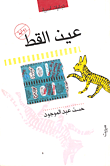
Book Review: Cat's Eyes (عين القط) by Hassan Abd El Maugoud: I stumbled upon this stylish little novella when I was browsing the Contemporary Arabic Fiction section in one of my favorite bookstores, and, I hate to admit, was attracted by its cover. I read the synopsis on the backcover and bought it on a whim. It was a good decision.

The novella tells the tale of a young boy - referred to throughout the novella only as Qot or Cat - living in a village in Upper Egypt with his conservative family, and who believes he can Astral-Project every night and inhabit the body of any stray cat. This allows him to prowl the village at night, sneak into houses undetected, and learn the village inhabitant's darkest secrets. Author Hassan Abd El Maugoud uses this intriguing premise as a launching pad for clever socio-political commentary, painting a not very pretty picture of living in a village in Egypt, which stands in for Egypt itself; a place which, as depicted in the story, is rife with corruption, bullies, unscrupulous politicians and sexual repression.

Although at times the pace becomes annoyingly frenetic, this short novella is filled to the brim with ideas and memorable characters, and the author's smooth, unpretentious style is addictive. A compelling, stylish read.

P.S. This novella has won the Saweris Award (2nd place) for outstanding first novel.

Saturday, March 20, 2010

Book Reviews

Book Review: Soloman's Ring (خاتم سليمان) by Sherif Meleika: Every once in a while, I come across a book that gives me hope for Egyptian literature. Despite the amount of literary junk that Egyptian writers have been producing this past decade (most of it pretentious, hypocritical non-fiction), there are some books out there that give one, as a reader as well as an Egyptian, hope that Egyptian writers still have masterpieces hidden under their sleeves. Mansoura Ezz El Din's Maryam's Maze is one such masterpiece. Soloman's Ring by Sherif Meleika is another.

This is a book that is admirable in its ambitiousness, hypnotic in its storytelling, elegant in its style, and, above all, one hell of a well-told story. Blending fact and fiction, real characters with fictitious ones (Gamal Abdel Nasser himself has a minor role in this tale), the story revolves around an Egyptian Jew named Dawood, whose life is turned upside down after the Military Coup d'etat and Nasser takes over as the first Egyptian President. After the jubilation and the first rays of hope die down, Dawood discovers that he's not welcome in his own country anymore, because he is a Jew. Meleika's novel dissects the Egyptian psyche, Nasser's and Sadat's regimes (warts and all), and the dual nature of War (it unites people under a cause, yet it reveals the ugliness and the weaknesses hidden within, which are only revealed under duress). Meleika also weaves a mythic thread into the tale, with a subplot involving a silver ring - hence the title of the novel - that Dawood buys from an old merchant, and which, seemingly, has mystical powers. Meleika uses the ring as a sort of McGuffin, a talisman that several characters, with various motives, want to wield in times of trouble. Arguably, the ring stands for clinging on to a straw during hard times, and for the power of faith, as well.

Spanning four decades of Egyptian history, with numerous characters and plot-lines, this a sweeping, ambitious, stylish novel, that is waiting to be discovered, read and analyzed; even if, at times, it becomes too sprawling for its own good. A masterpiece of modern Egyptian literature.

Book Review: The Waves of Autumn (أمواج الخريف) by Na'iem Sabry: This deceptively simple novel is a joy to read. With a straight-forward style, ebullient storytelling, and a masterful descriptive ability, writer Naiem Sabry does wonders with a cliched, simple plot. A sixty-year old artist vacationing in Rodos, Greece, discovers a new side to his personality when he decides to have an affair with a fellow traveler. But along with this newly found passion, he also discovers a hidden, lingering sense of regret buried deep within himself. He tries to confront himself and his weaknesses by seizing the day and making one daring choice after another, in an attempt to bring change into his life. But he discovers that change comes at a price. I couldn't tell you anymore of the plot, as it would be unfair to you and to the novel, which is brilliantly written and always one step ahead of the reader.

This novel, which reads like a collaboration between Henry James and Egyptian novelist Youssef El Seba'ey, is a touching, well-plotted tale, right down to its sad and darkly humorous ending.

Wednesday, March 10, 2010

Book Review

Book Review: The Song Of Solomon (نشيد الإنشاد) by Amir Ramses: The literary debut of Egyptian filmmaker Amir Ramses, The Song of Solomon is a stylish, heartfelt, and enjoyable piece of literary fiction. Focusing on a love triangle between the three central characters - Beatrice, a free-spirited young French woman, Osama, an Egyptian free-lance photographer who is both in love with Beatrice and Paris, and Salam, a Sufi
singer visiting paris for a series of concerts - this is a tale that, thanks to Ramses's smooth prose and his ability to draw realistic, endearing characters, is hopelessly romantic, beautifully sensual, and hauntingly atmospheric. For a first-time novelist, Rames surprisingly has a sharp sense of place; his descriptions of Paris, its people, streets, shops and bars, are wonderfully evocative without being long-winded, and despite a cliched ending and mostly stilted dialogue, this is a memorable and touchingly romantic novel, that is both modernist and reminiscent of classic romantic fiction.

Saturday, February 13, 2010

Book Reviews

Book Review: A Black Body Bag and other stories
(كيس أسود مخصص للأزبال)
by Khodeir Meirry
: One of the most under-appreciated Iraqi writers of contemporary fiction, Khodeir Meirry reaches new heights with this collection of short stories. From the bleak and strikingly graphic title story, about a young widow who goes to receive her son's corpse from Abu Ghareib prison and receives it in a plastic garbage bag, to the haunting delirium of The Hashish Tree, to the frightening portrayal of insanity and violence that is A Chant called Dodo, these stories encompass a wide range of emotions, yet focus, almost exclusively, on minds on the edge of collapse, on people whose inner demons are tearing them apart and whose sanity is about to give way to memories better left buried.
Despite Meirry's verbose style, the stories are fast paced and tightly-plotted. And although all his characters are more or less ravaged by the violence of war, Meirry is more interested in damaged psyches than in politics, resulting in stories that are nightmarish, surreal, terrifying, and, most importantly, possess a dark beauty that is rarely found in modern Arabic fiction. Highly recommended.

Book Review: Magaessee (المجسى) by Hagag Odoul: Nubian author Hagag Odoul, better known nowadays for his political writings, surprises and shocks with this novella, Magassee, a tale of werewolves, black magic and violence.
Telling the tale of a battle between two young warriors, one a kind-hearted young man who is out to unite his tribe and vanquish the evil that is threatening his clan, the other, the Magaessee of the title, is an evil shape-shifter, empowered by his ability to wield dark magic and change into a demonic werewolf.
Pulpy, nasty, violent and oversexed, this strange but stylish tale is a must for fans of weird fiction, and fans of fast-paced, purely plot-driven horror stories.

Book Review: The Tale of The Old Man Whom Whenever Dreams of a City , Dies There , and other stories ( حكاية رجل عجوز كلما حلم بمدينة . . مات فيها) by Tareq Imam: A new book by Tareq Imam, one of the most stylish and promising young Egyptian writers, means one thing. A non-stop reading binge.
Refining his style even more, Imam delivers 17 short stories (and some of them are indeed short, like Before we came to be, which is only a page long) that take you on a dark journey through nightmares, joys, pains, visions and revelations. Highlights include The City of Drowned Ghosts, a fine, hallucinatory, ghost story; Black Angel, an atmospheric, haunting, story, in which Imam manages to accomplish in one page what many authors fail to in a novel; and Moving, a superbly written, disturbing tale, about a female puppet master, who is, well, much more than that.
Reminiscent of some of the best works of Poe and Bradbury, yet stunningly original in their own right, these stories are a breath of fresh air, and a reminder that Imam is a singular talent to be reckoned with.
Saturday, February 6, 2010

Book Reviews

Book Review: Picasso's Fate ( مصير بيكاسو) by Mohamed Al 'Oun: Novels about writers are a dime a dozen; novels about Egyptian writers are few and mostly mediocre; good novels about Egyptian writers are almost non-existent. Therefore, Picasso's Fate by Mohamed El 'Awn should be cherished, read, then re-read. Yes, it's that good.

Revolving around the adventures of a lower/middle-class young man living in Cairo, his journey through several menial jobs, and his ambition to become a good writer, Picasso's Fate is an Egyptian novel of a rare breed. A novel that is deeply touching, realistic, funny, sad, yet ultimately uplifting, and one that lacks the bitter cynicism that seems to plague every other Egyptian novel about living in modern Cairo.

With good dialogue, believable characters, a compelling, straight-forward, almost minimalist style, this, the first novel by El 'Awn, promises good things to come from a new, singular, voice, and is one of the best novels about what being a writer in Egypt is really like. Highly recommended.

Book Review: The Genetic Maps Room ( حجرة الخرائط الجينية) by Islam Nada: Coming out of nowhere, this sweeping, fun, intelligent Science-Fiction novel for Young Adults is a treat. The plot - which revolves around a group of super-intelligent children genetically engineered to near-perfection, and chosen to live in a secret city that houses the world's greatest minds and works for the benefit of humanity - is high on imagination and takes place in a wonderfully appealing and thrillingly dangerous universe, integrating magic, djin, and demons into the Sci-Fi mix, and therefore delivering an entertaining Sci-Fi/fantasy epic for readers of all ages. Unmissable.

P.S. This novel is the first part of a trilogy, with the second installment (The Deadly Curse) already out!

Sunday, January 24, 2010

Book Review

Book review: Ghost stories Volume II: The Memoirs of a Psychiatrist ( حكايات الأشباح الجزء الثانى: يوميات طبيب نفسى) by Ola Barakat: Following her interesting, but hit and miss first collection of horror stories, Egyptian writer Ola Barakat delivers the goods with the second volume. Starting with the stylish and tremendously chilling interrelated stories The Memoirs of an insane woman and the title story, this collection takes the reader on a ride through the scary depths of Egyptian folklore and mythology, giving the stories a modern twist that makes them feel fresh.

With stories focusing on the Baron Palace, Djin, hauntings and insanity, this is a fine collection of Egyptian horror stories, written in Barakat's straightforward style, which makes it a quick and easy read, yet one filled with memorable imagery.

Can't wait for her to write a novel!

Saturday, January 16, 2010

Book Review


Book Review: Pardon me and other fears (أعذرينى و مخاوف أخرى) : There seems to be a horror literature renaissance taking place in Egypt. With more and more horror titles coming out every month, it isn't an overstatement to say that Egyptian horror fiction is alive and well. Pardon me and other fears, a collection of horror short stories by up and coming Egyptian writers, is one of the best of these titles.

With more than a dozen writers contributing to this collection, the reader is exposed to a myriad of styles. Some of the stories contained here are good, some are mediocre, but, mostly, they are all interesting, and sometimes even superb.

From Shaimaa El Sioufy's title story about a painter haunted by the ghost of his dead wife, to Hanan Abdel Ghafar's Liberation, a disturbing tale about the deadly wrath of a woman scorned, to Abdel Aziz Abo El Mirath's hallucinatory Night tales, which is made up of seemingly unrelated nightmarish vignettes, to the closing tale, Ismail Khaled Wahdan's clever The monsters of our city, this collection covers almost all of the standard plot devices (monsters, ghosts, demons, vampires . . .) and then some.

If this is any indication of things to come, then Egyptian horror sure has a bright future ahead of it.