Thursday, May 6, 2010

Beware The Stranger: Yes, it's a novel about vampires!

It seems that my plan, to keep the nature of my novel's villain a secret, has been foiled. The novel, Beware The Stranger, has been out since last Christmas, so I guess it was inevitable. The novel's official synopsis, which is available at the novel's website and which has been printed in several Egyptian magazines and newspapers, reads as follows:

"The novel revolves around the adventures of Ahmed and Amr (both 11 Years-Old), two best friends who love horror movies, love hanging out at the mall, but only like school. But their normal lives are turned upside down when one of them receives a warning from an old beggar, a man called Am Abdo, telling him that there is a killer loose on the streets of Cairo, and whom is out to get them. A killer who might not be human, but a monster who comes out at night, looking for blood!"

Yes. I know that the mention of a monster out looking for blood sort of gives a big clue. But, you see, I didn't want it known that the main villain of the novel is a vampire. Why? Because of a couple of things, really.

For one thing, the vampire fiction of late has been mostly awful, especially vampire fiction for Young Adults. You have manipulative, unimaginative dreck like the Twilight series, and numerous stories about teens turning into vampires and becoming tortured superheroes. To me, that's not the way vampires should be depicted. Vampire stories that I loved reading while growing up, the ones that stand the test of time - like Bram Stoker's Dracula, in which the grand daddy of all vampires is depicted as a monstrous, merciless creature of the night, whose nature is sadistic and who lacks any redeeming qualities - retain an ageless ability to haunt readers' nightmares decades, sometimes even centuries, after the novel is first published, mainly because of how memorably frightening the vampires/monsters in these stories are. Although I did like some of Anne Rice's novels about the anti-hero vampire Lestat, I could only bear them in small doses, and to me, they were never really frightening (well, maybe the first novel in the saga, Interview With The Vampire, was somewhat scary and disturbing).

The vampire in my book, Nina, is a monster. She abducts women and children, and traps them to feed on their blood. She is conniving, ruthless and, beneath her guise as a woman, looks like something out of a really bad nightmare. She scared the hell out of me when I was writing the book, and, hopefully, she scared readers as well.

During my book-signing tour (Beware! The Tour), I never mentioned that Beware The Stranger was, to some extent, a vampire novel; mainly because I think it is much more than that. It is more of a dark fantasy novel than a vampire novel, but, according to readers' emails, it is scary, even too scary for some children.

After getting emails from readers telling me that the novel is, according to them, a scary, vampire/horror novel, and that that should be made clear to readers, especially since the novel is marketed toward Young Adults, I decided to do just that by writing this piece.

So, I declare that Beware The Stranger is a vampire novel. There. It's done.

So, if you are between the ages of 10 and a 110, and you would like to read a story about vampires that are scary, monstrous and might give you nightmares, instead of reading about heart-throb vampires who are torn between loving helpless maidens or drinking their blood, read Beware The Stranger, you might like it.

- Beware The Stranger is available to buy in Egypt from these stores. For readers outside Egypt, it is available to buy from from Amazon Kindle, or from the publisher.

Tuesday, May 4, 2010

Book Reviews

Book Review: The Search (الطريق) by Naguib Mahfouz: Reviewing any piece of work by Naguib Mahfouz is a risky proposition. His work is both loved and over-analyzed; both cherished and reviled (yes, to this day, there are some people, especially Uber-Conservative Egyptians, who consider his work to be "immoral," due to Mahfouz's unflinching eye when it comes to describing some of the seedier aspects of Egyptian life). I have already attempted to review one of my favorite books of his, Midaq Alley (زقاق المدق). And I am going to try once more, with another of my favorites, The Search (الطريق).

The Search is, far and away, Mahfouz's most noirish work. The story of Saber, the son of a prostitute, who is forced, after his mother's death, to search for his absentee father, whom his mother claims is an "Egyptian gentleman" who will able to save him from an ugly life of pimping and petty-crime, is chock-full of all the main ingredients of livre-noir: The troubled anti-hero with a sordid past, the search for something elusive that promises salvation, the femme-fatale, and the overpowering sense of doom. Although Naguib Mahfouz's tales almost always have a norish bent, The Search is, arguably, his most obvious attempt at writing a piece of vintage noir. The sharp, hard-hitting dialogue, the descriptions of Cairo by night, the extremely complex character of Saber, who, throughout the tale, struggles with his own demons and penchant for violence and crime, the fast-pace, the downbeat, borderline nihilistic ending, all combine to make this a masterpiece of crime fiction, similar to the best works of James M. Cain.

A somewhat lesser-known part of his oeuvre, The Search is a fascinating novel that showcases Mahfouz at his most stylistically daring, and is a must for fans of livre-noir.

Book Review: Cities Without Palms (مدن بلا نخيل) by Tarek Eltayeb: Cities Without Palms by Tarek Eltayeb is an example of style over substance. The story (about a young Sudanese man who leaves his drought-stricken village and embarks on a journey to find money to support his family) is cliched, the plotting just about average, and the characters, although memorable, are not meticulously drawn. But its stylishness saves it. Author Eltayeb's style of prose and his superb command of pacing, turns this simple, ordinary tale into a compelling, fast-paced novella that is hard to put down once you start reading it. Also, Eltayaeb's masterful grasp of atmosphere and his ability to vividly describe a place with just a few well-chosen words, is in itself a marvel. And like all good writers, he makes it look easy, when really it isn't.

I for one can't wait to delve deeper into this writer's body of work (this is his first novel, originally published in 1992), which consists of several novels and short story collections, one of which is House Of Palms (بيت النخيل), a sequel to this novel. On its own, Cities Without Palms is a quick, enjoyable read, that promises great things to come.


Tuesday, April 20, 2010

Book Review


Book Review: A Matter of Time (مسألة وقت) by Montasser El Qafash: The winner of the 2009 Sawares Award for Best Work of Literature, A Matter of Time is a novel that is hard to review. It has an intriguing premise: a young man, who works as a part-time tutor to university students, has a one-night stand with one of his students, only to discover a little while later that she had died three hours before coming to his apartment and sleeping with him. Baffled, the young man, who feels he is just coasting through life, starts an investigation into the young woman's past, which leads him to a friend of hers, a young woman named Nahed, who claims to have also been visited by the young woman's apparition.

Author Montasser El Qafash uses this central plot-line more or less as a McGuffin to delve deeper into his characters' lives and psyches. And herein lies the problem. His characters are pretty aimless, which I understand is intentional, since the whole novella seems to be a study of what happens to regular people, leading ordinary, mundane lives, when they are confronted by something that challenges their sense of reality. But aimless characters leading aimless lives don't make for a very gripping read. Which is not to say that this novel is bad. Far from it. It's atmospheric, stylishly written, and has a fascinating premise. But one can't help but feel that it would have made a great short story. As a novel, even a short one, it seems overlong and, ultimately, underwhelming.

Thursday, April 8, 2010

Book Review

Book Review: Solo Piano Music (عزف منفرد على البيانو) by Fawaz Haddad: This masterful psychological thriller is like no other Arabic book I've ever come across. It combines aspects of the spy genre, the Jamesian Psychological drama, with thought-provoking existentialism, to produce a fine, ambitious thriller.

The plot - revolving around a secular Syrian writer and government official who, after getting attacked and beaten by a mysterious figure and becoming a sort of a celebrity, is entangled in a complex plot involving negotiations between the Syrian Government and Extremist Islamists - is layered, and at times dizzyingly complex. But author Fawaz Haddad's grasp of his characters, especially the protagonist, Fateh, that makes the reader want to tag along for this long and complicated journey. And a journey it is. Featuring a myriad of complex characters, shadowy goings-on, flashbacks and political intrigue, this isn't the easiest of reads. But Haddad's smooth prose, meticulous plotting, a fascinating supporting character (Selim, the enigmatic counter-terrorism agent), and a hell of a twist ending, all combine to make this a thriller worth spending some time and energy with. Highly Recommended.

Friday, April 2, 2010

Book Review

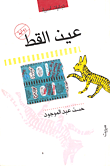
Book Review: Cat's Eyes (عين القط) by Hassan Abd El Maugoud: I stumbled upon this stylish little novella when I was browsing the Contemporary Arabic Fiction section in one of my favorite bookstores, and, I hate to admit, was attracted by its cover. I read the synopsis on the backcover and bought it on a whim. It was a good decision.

The novella tells the tale of a young boy - referred to throughout the novella only as Qot or Cat - living in a village in Upper Egypt with his conservative family, and who believes he can Astral-Project every night and inhabit the body of any stray cat. This allows him to prowl the village at night, sneak into houses undetected, and learn the village inhabitant's darkest secrets. Author Hassan Abd El Maugoud uses this intriguing premise as a launching pad for clever socio-political commentary, painting a not very pretty picture of living in a village in Egypt, which stands in for Egypt itself; a place which, as depicted in the story, is rife with corruption, bullies, unscrupulous politicians and sexual repression.

Although at times the pace becomes annoyingly frenetic, this short novella is filled to the brim with ideas and memorable characters, and the author's smooth, unpretentious style is addictive. A compelling, stylish read.

P.S. This novella has won the Saweris Award (2nd place) for outstanding first novel.

Saturday, March 20, 2010

Book Reviews

Book Review: Soloman's Ring (خاتم سليمان) by Sherif Meleika: Every once in a while, I come across a book that gives me hope for Egyptian literature. Despite the amount of literary junk that Egyptian writers have been producing this past decade (most of it pretentious, hypocritical non-fiction), there are some books out there that give one, as a reader as well as an Egyptian, hope that Egyptian writers still have masterpieces hidden under their sleeves. Mansoura Ezz El Din's Maryam's Maze is one such masterpiece. Soloman's Ring by Sherif Meleika is another.

This is a book that is admirable in its ambitiousness, hypnotic in its storytelling, elegant in its style, and, above all, one hell of a well-told story. Blending fact and fiction, real characters with fictitious ones (Gamal Abdel Nasser himself has a minor role in this tale), the story revolves around an Egyptian Jew named Dawood, whose life is turned upside down after the Military Coup d'etat and Nasser takes over as the first Egyptian President. After the jubilation and the first rays of hope die down, Dawood discovers that he's not welcome in his own country anymore, because he is a Jew. Meleika's novel dissects the Egyptian psyche, Nasser's and Sadat's regimes (warts and all), and the dual nature of War (it unites people under a cause, yet it reveals the ugliness and the weaknesses hidden within, which are only revealed under duress). Meleika also weaves a mythic thread into the tale, with a subplot involving a silver ring - hence the title of the novel - that Dawood buys from an old merchant, and which, seemingly, has mystical powers. Meleika uses the ring as a sort of McGuffin, a talisman that several characters, with various motives, want to wield in times of trouble. Arguably, the ring stands for clinging on to a straw during hard times, and for the power of faith, as well.

Spanning four decades of Egyptian history, with numerous characters and plot-lines, this a sweeping, ambitious, stylish novel, that is waiting to be discovered, read and analyzed; even if, at times, it becomes too sprawling for its own good. A masterpiece of modern Egyptian literature.

Book Review: The Waves of Autumn (أمواج الخريف) by Na'iem Sabry: This deceptively simple novel is a joy to read. With a straight-forward style, ebullient storytelling, and a masterful descriptive ability, writer Naiem Sabry does wonders with a cliched, simple plot. A sixty-year old artist vacationing in Rodos, Greece, discovers a new side to his personality when he decides to have an affair with a fellow traveler. But along with this newly found passion, he also discovers a hidden, lingering sense of regret buried deep within himself. He tries to confront himself and his weaknesses by seizing the day and making one daring choice after another, in an attempt to bring change into his life. But he discovers that change comes at a price. I couldn't tell you anymore of the plot, as it would be unfair to you and to the novel, which is brilliantly written and always one step ahead of the reader.

This novel, which reads like a collaboration between Henry James and Egyptian novelist Youssef El Seba'ey, is a touching, well-plotted tale, right down to its sad and darkly humorous ending.

Wednesday, March 10, 2010

Book Review

Book Review: The Song Of Solomon (نشيد الإنشاد) by Amir Ramses: The literary debut of Egyptian filmmaker Amir Ramses, The Song of Solomon is a stylish, heartfelt, and enjoyable piece of literary fiction. Focusing on a love triangle between the three central characters - Beatrice, a free-spirited young French woman, Osama, an Egyptian free-lance photographer who is both in love with Beatrice and Paris, and Salam, a Sufi
singer visiting paris for a series of concerts - this is a tale that, thanks to Ramses's smooth prose and his ability to draw realistic, endearing characters, is hopelessly romantic, beautifully sensual, and hauntingly atmospheric. For a first-time novelist, Rames surprisingly has a sharp sense of place; his descriptions of Paris, its people, streets, shops and bars, are wonderfully evocative without being long-winded, and despite a cliched ending and mostly stilted dialogue, this is a memorable and touchingly romantic novel, that is both modernist and reminiscent of classic romantic fiction.